Grounded: The Structural Barriers Keeping American Robotics From Leaving the Lab
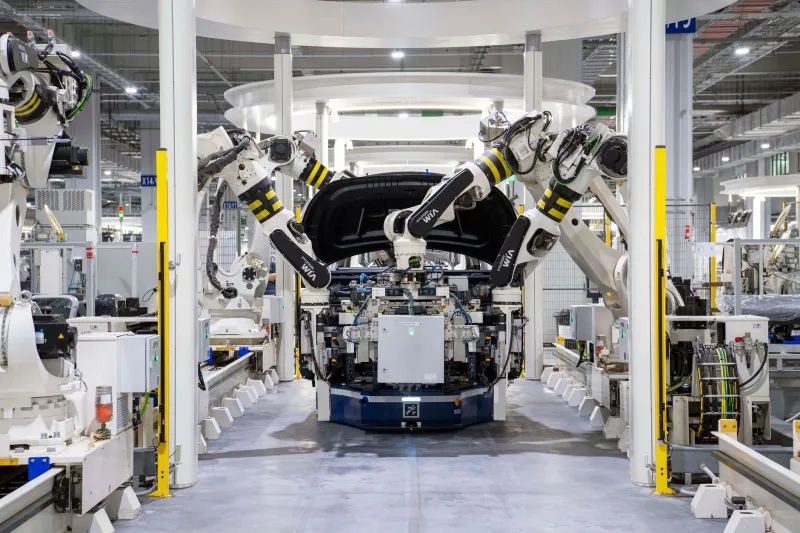
Visit any major robotics trade show—Automate in Detroit, ProMat in Chicago—and the demonstrations are genuinely impressive. Autonomous mobile robots navigate crowded warehouse floors with fluid precision. Collaborative arms perform intricate assembly tasks alongside human workers. Humanoid platforms, still early-stage but increasingly capable, sort packages and move through unstructured environments that would have confounded their predecessors entirely.
Then visit the average American factory or fulfillment center, and the contrast is jarring. Manual labor remains the dominant mode of operation across vast swaths of US manufacturing and logistics. The International Federation of Robotics consistently ranks the United States well behind Germany, South Korea, Japan, and even China in robot density—the number of industrial robots deployed per 10,000 manufacturing workers. In 2023, the US figure stood at approximately 285. South Korea's was 1,012.
This is not a story about technological inadequacy. American research institutions and venture-backed startups are producing robotics innovation at a pace that rivals any country on earth. The bottleneck is not in the laboratory. It is in the long, expensive, and structurally fragmented journey from prototype to production floor.
The Integrator Shortage Nobody Talks About
Deploying an industrial robot is not like installing enterprise software. It requires physical integration into an existing facility—mechanical mounting, electrical infrastructure, safety enclosures, sensor calibration, and extensive programming to adapt the system to a specific workflow. This work is performed by systems integrators: specialized firms that bridge the gap between a robot manufacturer's hardware and an end customer's operational environment.
The United States has a significant and growing shortage of qualified integrators. The Association for Advancing Automation estimates that demand for integration services is outpacing the supply of trained professionals by a widening margin. The pipeline problem is structural: integration work requires a rare combination of mechanical engineering knowledge, software programming capability, and hands-on industrial experience that takes years to develop and is not well-served by existing vocational or university curricula.
For a mid-sized manufacturer in Ohio or Tennessee considering a robotics investment, this shortage translates directly into extended project timelines and inflated implementation costs. A robotic welding cell that costs $150,000 in hardware may require an equal or greater sum in integration services, and then face a six-to-twelve-month wait for an integrator with available capacity. For many smaller manufacturers operating on thin margins, that calculus does not resolve in favor of automation.
Regulatory Fragmentation as a Deployment Tax
The United States' federal structure, generally an asset for economic dynamism, creates a specific liability in robotics deployment: the absence of a unified regulatory framework. Safety standards for autonomous mobile robots, collaborative systems, and drone-enabled logistics vary not just between federal agencies—OSHA, the FAA, state labor departments—but between states and, in some cases, between municipalities.
A logistics company deploying autonomous ground vehicles across a multi-state distribution network must navigate this patchwork individually. A robot that meets OSHA's general industry safety standards in one configuration may require modification or re-certification to operate in a facility governed by a different state's occupational safety regime. Drone-assisted inventory management in a warehouse requires FAA compliance that does not neatly accommodate indoor operations, creating ambiguity that risk-averse legal teams routinely resolve by advising against deployment.
Compare this to the European Union's emerging machinery regulation and AI Act framework, which—whatever their imperfections—provide manufacturers and deployers with a single, harmonized compliance target. Germany's robotics adoption advantage is not explained by culture or engineering talent alone. It is partly explained by the lower regulatory transaction costs its manufacturers face.
The Hidden Infrastructure Cost
The price of a robot appears on a purchase order. The infrastructure required to support it often does not appear until well into a deployment project, at which point it arrives as a series of unwelcome surprises.
Many American manufacturing facilities, particularly in the industrial Midwest, were built in the mid-twentieth century and have not received significant structural investment since. Floors that appear adequate may lack the levelness tolerances required for autonomous mobile robot navigation. Electrical systems may be insufficient to support the power demands of new automation equipment. Wireless connectivity—essential for any networked robotic system—is frequently inadequate in large metal-walled industrial structures where signals attenuate unpredictably.
Upgrading a facility to meet these requirements can cost more than the robotics systems themselves. For a manufacturer weighing automation against other capital priorities, this hidden cost frequently tips the analysis toward deferral. The robot never ships because the building was not ready for it.
Where Traction Actually Exists
Acknowledging these barriers does not require dismissing the progress that is genuinely occurring. Several robotics segments are achieving meaningful deployment scale in the United States, and examining them reveals which conditions enable adoption.
Autonomous mobile robots in e-commerce fulfillment represent the clearest success story. Amazon's Kiva-derived systems, along with deployments from 6 River Systems, Locus Robotics, and Fetch Robotics, operate in purpose-built or significantly retrofitted facilities where infrastructure was designed around the technology from the outset. The lesson is that greenfield or heavily renovated environments dramatically reduce integration friction.
Agricultural robotics is gaining traction in specialty crop harvesting, driven by a labor shortage that is both severe and politically intractable. When the alternative is unharvested product, the economics of automation become compelling even at current cost levels. Startups including Abundant Robotics and Tortuga AgTech have demonstrated that sufficient pain in a labor market accelerates adoption regardless of other barriers.
In semiconductor fabrication—a sector receiving substantial federal investment through the CHIPS and Science Act—highly automated facilities are being built from scratch with robotics integration as a foundational design element rather than a retrofit consideration. This represents a model worth examining for what it reveals: when capital is abundant, timelines are long, and facilities are purpose-built, robotics adoption follows naturally.
The Inflection Point Conditions
For the broader US robotics market to reach the density levels of its peer competitors, several conditions must converge. Workforce development programs specifically targeting systems integration—at community colleges, through apprenticeship programs, and in partnership with robotics manufacturers—are necessary to address the integrator shortage before it becomes a permanent ceiling on deployment rates.
Regulatory harmonization, while politically complex, is achievable through coordination between federal agencies and state governments on baseline safety standards for common robot categories. The National Institute of Standards and Technology has the mandate and technical expertise to facilitate this process; what has been lacking is the political prioritization.
Perhaps most importantly, the financing models available to manufacturers for robotics investment need to evolve. Robotics-as-a-service models, which convert capital expenditure into operating expenditure and shift integration risk to the provider, are expanding but remain immature. As these models scale, they will bring automation within reach of manufacturers who currently cannot absorb the upfront cost, regardless of the long-term return.
The technology is ready. The American industrial base, with the right structural support, is ready to receive it. What remains is the less glamorous work of building the ecosystem conditions that allow innovation to travel the distance from demonstration to deployment—a last mile that requires policy, investment, and institutional commitment as much as engineering.